
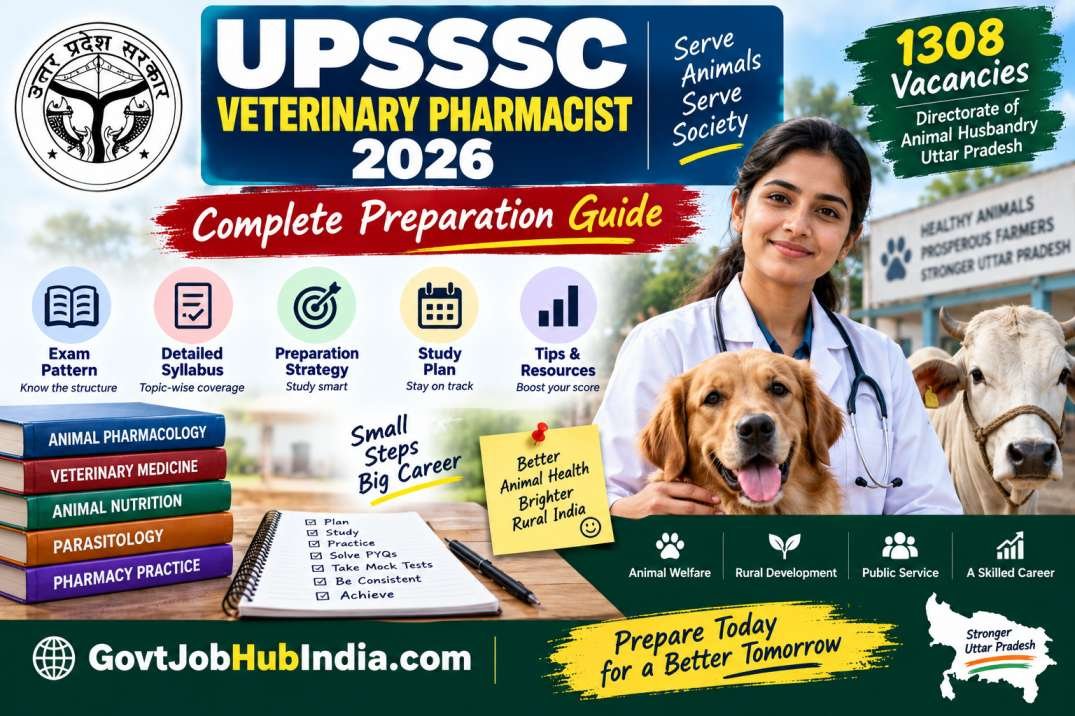
If yUPSSSC Veterinary Pharmacist 2026ou are preparing for the UPSSSC Veterinary Pharmacist Recruitment 2026, then your preparation should be completely different from a general government job examination.
This is a specialised recruitment in which the largest portion of the written examination is based on Veterinary Pharmacist subject knowledge. Therefore, candidates should not prepare only General Knowledge or Current Affairs and expect to score well.
The right preparation strategy should focus on three major areas:
Veterinary Pharmacist Subject Knowledge + Computer & IT + Uttar Pradesh General Knowledge
According to the 2026 recruitment information, the Uttar Pradesh Subordinate Services Selection Commission (UPSSSC) has notified recruitment for 1,308 Veterinary Pharmacist posts under the Directorate of Animal Husbandry, Uttar Pradesh. The Main Examination is linked to PET-2025, and candidates are shortlisted for the Main Examination based on their PET-2025 score.
The written examination consists of 100 objective questions for 100 marks, with a total duration of 2 hours. The paper is divided into three parts:
- Veterinary Pharmacist Subject Knowledge – 65 marks
- Computer & Information Technology – 15 marks
- General Information Related to Uttar Pradesh – 20 marks
There is also one-fourth negative marking for each wrong answer.
This means that your preparation should be accuracy-oriented from the beginning.
In this complete guide, we will explain how to prepare for UPSSSC Veterinary Pharmacist 2026, complete syllabus, subject-wise strategy, daily study plan, PYQ strategy, revision method, mock-test strategy and common mistakes.
UPSSSC Veterinary Pharmacist Recruitment 2026: Quick Overview
| Particular | Details |
|---|---|
| Exam Name | UPSSSC Veterinary Pharmacist Main Examination 2026 |
| Recruiting Body | Uttar Pradesh Subordinate Services Selection Commission (UPSSSC) |
| Department | Directorate of Animal Husbandry, Uttar Pradesh |
| Advertisement | 18-Pariksha/2026 |
| Post | Veterinary Pharmacist |
| Total Vacancies | 1,308 |
| Eligibility Route | PET-2025 based shortlisting |
| Examination Type | Objective Multiple Choice |
| Total Questions | 100 |
| Total Marks | 100 |
| Exam Duration | 2 Hours |
| Negative Marking | 1/4 mark per wrong answer |
| Selection Basis | Written Main Examination |
| Official Website | upsssc.gov.in |
The 2026 recruitment information identifies 1,308 Veterinary Pharmacist vacancies and states that candidates are shortlisted for the Main Examination based on their normalized PET-2025 score.
How to Prepare for UPSSSC Veterinary Pharmacist Recruitment 2026?
The first thing candidates need to understand is that this is not a general SSC-type examination.
In SSC CGL, for example, Maths, Reasoning, English and General Awareness dominate the preparation.
But in UPSSSC Veterinary Pharmacist, 65% of the written paper is dedicated to subject-related knowledge.
Therefore, if you are serious about this examination, approximately two-thirds of your preparation time should go toward the Veterinary Pharmacist syllabus.
A practical preparation formula is:
65% Veterinary Subject + 15% Computer/IT + 20% Uttar Pradesh GK
This does not mean you should completely ignore one section. The purpose is to allocate your preparation time according to the marks distribution.
UPSSSC Veterinary Pharmacist Exam Pattern 2026
The Main Examination contains one objective question paper.
| Part | Subject | Marks |
|---|---|---|
| Part 1 | Subject-Related Knowledge | 65 |
| Part 2 | Computer & Information Technology Concepts | 15 |
| Part 3 | General Information Related to Uttar Pradesh | 20 |
| Total | 100 |
The examination has 100 MCQs, carries 100 marks, and has a duration of 120 minutes. One-fourth of the marks assigned to a question is deducted for an incorrect answer.
Therefore, candidates should not follow a blind guessing strategy.
Your target should be:
High Accuracy + Good Attempt Selection + Proper Time Management
UPSSSC Veterinary Pharmacist Syllabus 2026
The syllabus is divided into three major sections.
Part 1: Veterinary Pharmacist Subject Knowledge – 65 Marks
This is the most important section of the examination.
The prescribed syllabus covers 15 broad areas.
These include:
- Structure of Animals and Poultry
- Animal Husbandry Management
- Animal Breeds and Economic Traits
- Animal Nutrition and Health
- Animal Physiology
- Clinical Pathology
- Parasitology
- Pharmacology
- Clinical Biochemistry and Gynaecology
- Clinical Veterinary Medicine
- Veterinary Clinical Pharmacy
- Surgical Procedures
- Pharmacist Jurisprudence
- Farm Management and Extension
- Hospital Practice
The current 2026 syllabus references identify these as the major subject areas for the 65-mark professional section.
Let’s understand how you should prepare each area.
1. Structure of Animals and Poultry
This section deals with basic animal anatomy.
Focus on:
- Skeletal system
- Major bones
- Joints
- Digestive system
- Respiratory system
- Circulatory system
- Urogenital system
- Nervous system
- Sense organs
- Superficial lymph nodes
The important point is to understand the basic structure and function of major organs.
Do not simply memorise isolated facts.
Create diagrams and short notes wherever possible.
2. Animal Husbandry Management
This section focuses on the management of livestock.
Prepare:
- Basic terminology
- Cattle management
- Buffalo management
- Sheep management
- Goat management
- Horse management
- Camel management
- Pig management
- Animal housing
- Grooming
- Bathing
- Dipping
- Shearing
- Care of pregnant animals
- Newborn calf management
- Dehorning
- Castration
This topic is highly practical, so prepare it from an examination as well as application perspective.
3. Animal Breeds and Economic Traits
Candidates should study the identification and characteristics of important breeds.
Focus on:
- Indigenous breeds
- Exotic breeds
- Crossbred animals
- Cattle breeds
- Buffalo breeds
- Sheep breeds
- Goat breeds
- Horse breeds
- Basic breeding systems
- Inbreeding
- Crossbreeding
- Farm records
- Economic traits
Make comparison tables for breeds.
For example:
Breed → Species → Region → Important characteristic → Economic importance
This makes revision much easier.
4. Animal Nutrition and Health
Animal nutrition is another important part of the professional syllabus.
Study:
- Types of fodder
- Balanced ration
- Nutrients
- Nutritional requirements
- Deficiency diseases
- Signs of poor nutrition
- Basic animal health
Instead of memorising everything together, divide the subject into:
Nutrient → Source → Function → Deficiency → Symptoms
This approach makes factual information easier to remember.
5. Animal Physiology
Focus on the physiological functions of major organs.
Important areas include:
- Digestive system
- Respiratory system
- Circulatory system
- Nervous system
- Excretory system
- Reproductive system
- Endocrine functions
- Basic physiological processes
Conceptual understanding is important here because many questions can be based on the relationship between an organ and its function.
6. Clinical Pathology
Prepare the fundamentals of:
- Laboratory equipment
- Sterilization
- Blood examination
- Urine examination
- Stool examination
- Sample collection
- Sample processing
- Basic laboratory procedures
Make short notes on the purpose of common laboratory tests and equipment.
7. Parasitology
This section includes basic knowledge of parasites affecting animals.
Study:
- Internal parasites
- Worms
- Flukes
- External parasites
- Ticks
- Mites
- Lice
- Parasite life cycles
- General deworming concepts
Create tables for:
Parasite → Host → Disease/Effect → Identification → Control
This is much easier to revise than long paragraphs.
8. Pharmacology
For Veterinary Pharmacist candidates, Pharmacology should receive special attention.
Prepare:
- Drug classification
- Sources of drugs
- Routes of administration
- Oral administration
- Injection
- Ointments
- Dosage calculation
- Side effects
- Drug storage
- Basic veterinary drug use
The syllabus specifically includes basic principles of pharmacology, drug classification, administration, dosage, adverse effects and storage.
Make a separate revision notebook for important drug classifications and concepts.
9. Clinical Biochemistry and Gynaecology
Prepare the basics of:
- Clinical biochemistry
- Important biochemical parameters
- Laboratory interpretation fundamentals
- Reproductive system
- Basic veterinary gynaecology
Keep the preparation focused on the prescribed syllabus rather than unnecessarily going into advanced medical concepts.
10. Clinical Veterinary Medicine
This section requires understanding of basic veterinary clinical practice.
Focus on:
- Common animal diseases
- Clinical signs
- Basic diagnosis
- General treatment principles
- Prevention
- Animal health management
Prepare disease-based notes.
A useful format is:
Disease → Cause → Symptoms → Diagnosis → Prevention/Management
11. Veterinary Clinical Pharmacy
This section should be given special attention because it directly relates to the role of a Veterinary Pharmacist.
Study:
- Veterinary medicines
- Drug administration
- Dosage
- Prescription basics
- Drug handling
- Storage
- Medication safety
- Clinical pharmacy principles
Do not study Pharmacology and Clinical Pharmacy as completely separate subjects. Connect the concepts while revising.
12. Preliminary Surgical Procedures
Focus on the basics of:
- Surgical preparation
- Sterilization
- Instruments
- Basic procedures
- Wound management
- First-aid concepts
- Basic surgical precautions
The objective should be to understand the role of a pharmacist/support professional in veterinary clinical practice.
13. Pharmacist Jurisprudence
This section is important because it deals with legal and professional aspects.
Prepare:
- Professional responsibilities
- Legal aspects of pharmacy practice
- Drug-related rules
- Record keeping
- Storage requirements
- Ethical responsibilities
- Relevant veterinary pharmacy regulations
Because legal topics can be factual, make concise notes and revise them repeatedly.
14. Farm Management and Extension
Prepare:
- Farm management
- Farm economics
- Livestock management
- Record keeping
- Extension principles
- Farmer education
- Animal husbandry extension
Focus on definitions, principles and practical applications.
15. Hospital Practice
This includes practical aspects of veterinary hospital work.
Prepare:
- Hospital procedures
- Patient handling
- Drug storage
- Record maintenance
- Sterilization
- Basic clinical support
- Pharmacy-related hospital practices
This section is relatively small in the syllabus, but candidates should not ignore it because questions can come from any prescribed topic.
Part 2: Computer & Information Technology – 15 Marks
Computer and IT carries 15 marks, so it can become a useful scoring section.
The syllabus includes areas such as:
- History of computers
- Applications of computers
- Hardware
- Software
- Input devices
- Output devices
- Operating systems
- Internet
- World Wide Web
- IP addressing
- MS Word
- MS Excel
- Networking
- Social networking
- E-governance
- Digital financial tools
- Cyber security
- Artificial Intelligence
- Big Data
- Deep Learning
- Machine Learning
- Internet of Things
These areas are included in current 2026 syllabus references.
Computer Preparation Strategy
Do not spend weeks watching advanced computer lectures.
Study the basic concepts and then solve MCQs.
For example:
Hardware → Software → Internet → MS Office → Networking → Cyber Security → Emerging Technology
This sequence is sufficient for structured preparation.
Part 3: General Information Related to Uttar Pradesh – 20 Marks
This section carries 20 marks, making it extremely important.
Prepare Uttar Pradesh-specific:
History
- Ancient history
- Medieval history
- Modern history
- Freedom movement
- Important historical places
Culture
- Art
- Architecture
- Festivals
- Folk dances
- Literature
- Regional languages
- Heritage
- Social customs
Geography
- Rivers
- Climate
- Soil
- Forests
- Wildlife
- Natural resources
- Minerals
- Major geographical features
Economy
- Agriculture
- Industries
- Business
- Employment
- Major economic activities
Polity and Administration
- State government
- Administration
- Important institutions
- State-level governance
Current Affairs
Focus on:
- Uttar Pradesh government schemes
- Important appointments
- Major projects
- Infrastructure
- Agriculture
- Industry
- Sports
- Awards
- Important state events
- Current developments
The UP-specific section covers history, culture, geography, economy, agriculture, industry, polity, administration and current affairs.
How Many Hours Should You Study for Veterinary Pharmacist?
This depends on your current level.
If you are a beginner, start with approximately 4–5 focused hours.
If you are a serious full-time aspirant, 6–8 focused hours can be useful.
But remember:
8 hours sitting is not equal to 8 hours studying.
Your study time should contain:
- Concept learning
- MCQ practice
- PYQs
- Revision
- Mock tests
- Mistake analysis
Daily Study Plan for UPSSSC Veterinary Pharmacist
A practical 6-hour schedule could look like this:
| Time | Activity |
|---|---|
| 2 Hours | Veterinary Pharmacist Subject |
| 1 Hour | Veterinary MCQs/PYQs |
| 1 Hour | Uttar Pradesh GK |
| 45 Minutes | Computer & IT |
| 45 Minutes | Current Affairs |
| 30 Minutes | Revision |
If your professional subjects are weak, increase Veterinary preparation to 3–4 hours.
The important point is to follow the 65:15:20 marks ratio while planning your study time.
60-Day Preparation Strategy
If you have around two months, divide your preparation into three phases.
Phase 1: Days 1–25
Complete the professional subject basics.
Focus on:
- Anatomy
- Animal Husbandry
- Breeds
- Nutrition
- Physiology
- Pathology
- Parasitology
- Pharmacology
Start Computer and UP GK simultaneously.
Phase 2: Days 26–45
Complete the remaining professional subjects:
- Clinical Biochemistry
- Gynaecology
- Clinical Medicine
- Clinical Pharmacy
- Surgery
- Jurisprudence
- Farm Management
- Hospital Practice
Increase MCQ practice.
Phase 3: Days 46–60
Now focus mainly on:
- Revision
- PYQs
- Mock Tests
- UP GK revision
- Computer MCQs
- Professional subject MCQs
- Mistake notebook
Do not keep adding new books during this phase.
How to Use Previous Year Questions?
PYQs are extremely important, but don’t depend only on memory-based questions if the exact previous paper is unavailable.
Use questions from:
- Previous UPSSSC Veterinary Pharmacist examinations
- Relevant veterinary pharmacy examinations
- Topic-wise professional MCQs
- Syllabus-based practice tests
After completing every chapter:
Concept → MCQs → PYQs → Revision
This should become your standard study cycle.
Mock Test Strategy
Because the paper contains 100 questions in 120 minutes, you have an average of around 1.2 minutes per question.
However, you should not spend exactly the same amount of time on every question.
Use three categories:
Category A – Easy
Solve immediately.
Category B – Moderate
Solve after the easy questions.
Category C – Difficult
Return to these questions later.
Because there is 25% negative marking, avoid unnecessary guessing.
Most Common Mistakes in Veterinary Pharmacist Preparation
1. Ignoring Professional Subjects
The Veterinary section carries 65 marks, so this should remain your biggest priority.
2. Studying Only Pharmacology
The examination covers much more than Pharmacology.
Anatomy, nutrition, pathology, parasitology, medicine, clinical pharmacy and other areas are also included.
3. Ignoring Uttar Pradesh GK
UP GK carries 20 marks.
That is one-fifth of the complete paper.
4. Ignoring Computer
Computer carries 15 marks and should not be left for the last week.
5. Reading Without MCQs
Reading creates familiarity.
Questions create exam readiness.
6. No Revision
Professional subjects contain a large amount of factual information.
Without revision, retention will drop.
7. Guessing Due to Exam Pressure
Negative marking makes accuracy important.
Best Revision Technique
Make three notebooks.
Notebook 1 – Veterinary Short Notes
Use it for:
- Diseases
- Drugs
- Breeds
- Anatomy
- Parasites
- Nutrition
- Important facts
Notebook 2 – Uttar Pradesh GK
Use it for:
- History
- Geography
- Culture
- Economy
- Government schemes
- Current affairs
Notebook 3 – Mistake Notebook
Whenever you answer a question incorrectly, write:
Question → Correct Answer → Why I Got It Wrong
Revise this notebook before every mock.
Teacher’s Rule for UPSSSC Veterinary Pharmacist Preparation
If I were teaching you for this examination in a classroom, I would give you one simple rule:
Do not study merely to complete the syllabus. Study until you can solve questions from the syllabus.
For example, completing Pharmacology does not mean you have mastered Pharmacology.
You should be able to:
- Identify drug classifications
- Understand routes of administration
- Answer dosage-related questions
- Identify storage requirements
- Understand basic adverse effects
- Solve MCQs accurately
That is actual exam preparation.
UPSSSC Veterinary Pharmacist Preparation Formula
Remember this formula:
Concept → Short Notes → MCQs → PYQ → Revision → Mock Test → Mistake Analysis
Repeat this cycle for every major topic.
For the professional section, give maximum time.
For UP GK, focus on state-specific information.
For Computer, focus on concepts and objective questions.
Frequently Asked Questions – UPSSSC Veterinary Pharmacist 2026
How many vacancies are available for UPSSSC Veterinary Pharmacist Recruitment 2026?
The 2026 recruitment notification is reported for 1,308 Veterinary Pharmacist posts.
Who can appear in the UPSSSC Veterinary Pharmacist Main Examination?
The recruitment is linked to PET-2025, and candidates are shortlisted for the Main Examination based on their PET-2025 score and the applicable eligibility requirements.
How many questions are asked in the Veterinary Pharmacist Main Examination?
The paper contains 100 objective questions carrying 100 marks.
What is the duration of the examination?
Candidates get 2 hours (120 minutes) to complete the written examination.
Is there negative marking?
Yes. The reported examination scheme provides for a one-fourth deduction of the marks assigned to the question for every incorrect answer.
Which section carries the highest marks?
Veterinary Pharmacist Subject Knowledge carries the highest weightage with 65 marks out of 100.
How many marks are for Computer?
The Computer and Information Technology section carries 15 marks.
How many marks are for Uttar Pradesh GK?
General Information related to Uttar Pradesh carries 20 marks.
Final Strategy for UPSSSC Veterinary Pharmacist 2026
The most important thing to understand is that this examination is highly subject-oriented.
If you are preparing seriously, your first priority should be the 65-mark Veterinary Pharmacist section.
After that, prepare the 20-mark Uttar Pradesh section and 15-mark Computer/IT section.
Your preparation should follow this structure:
Veterinary Pharmacist – 65%
Anatomy + Animal Husbandry + Breeds + Nutrition + Physiology + Pathology + Parasitology + Pharmacology + Clinical Subjects + Surgery + Jurisprudence + Farm Management + Hospital Practice
Computer & IT – 15%
Computer Basics + Hardware + Software + Internet + MS Office + Networking + Cyber Security + Emerging Technologies
Uttar Pradesh GK – 20%
History + Culture + Geography + Economy + Polity + Administration + Agriculture + Industry + Current Affairs
And finally:
PYQ + Revision + Mock Test + Mistake Analysis
This is the preparation cycle you should follow until the examination.
Do not waste your preparation time collecting unlimited PDFs and changing study sources every few days.
Choose reliable study material, complete the prescribed syllabus, solve questions and revise repeatedly.
The most important principle is simple:
Read less, revise more, practice more and make fewer mistakes.
For any change in vacancy, eligibility, application dates, examination schedule or syllabus, candidates should verify the latest notification/rulebook directly on the official UPSSSC website, because the Commission’s official notice is the controlling source. The 2026 recruitment is Advertisement No. 18-Pariksha/2026 for the Veterinary Pharmacist Main Examination linked to PET-2025.
How should I prepare for UPSSSC Veterinary Pharmacist 2026?
Prepare in three parts: give maximum priority to the 65-mark Veterinary Pharmacist syllabus, followed by 15 marks Computer & IT and 20 marks Uttar Pradesh General Knowledge. Complete the professional syllabus topic-wise, solve MCQs/PYQs, revise regularly and take full-length mock tests while maintaining high accuracy because the exam has 25% negative marking.
Important Links – UPSSSC Veterinary Pharmacist Recruitment 2026
| Particulars | Important Link |
|---|---|
| Apply Online | Click Here to Apply Online |
| Official Notification | Click Here to Visit UPSSSC Website |
| Official Website | Click Here to Visit UPSSSC |
Latest Government Jobs
| Latest Job Update | Read Full Details |
|---|---|
| UIIC AO Recruitment 2026 – Administrative Officer Posts | Read More |
| MP Police Constable Recruitment 2026 – 7,500 Posts | Read More |
| RRB Paramedical Recruitment 2026 – 560 Posts | Read More |
| SSC CHSL Recruitment 2026 – 2,536 Posts | Read More |
| UPSSSC Computer Operator Recruitment 2026 – 12 Posts | Read More |